What was announced
In November 2015 the Plan wrote to pensioners announcing “a special increase” for the parts of their pension that do not increase automatically. Broadly, that meant pension earned before April 1997 above the Guaranteed Minimum Pension (GMP). The increase had “been worked out as 19.1% — which is 90% of the rise in inflation (using the Consumer Price Index) between December 2006 and May 2013.” It took effect from January 2014 and was paid in December 2015, with two years’ arrears.1[1]Plan letter to pensioners, November 2015, issued by J & J Pension Trustees Limited, c/o Mercer Limited: special increase of 19.1%, effective January 2014, paid December 2015.
The letter explained why 90%: “This is the level of inflation protection the Company has targeted for discretionary increases of this nature.” It also set a ceiling: “the maximum extra pension will be £1,000 a year”, double the £500 cap on the previous increase, because “the increase this time of 19.1% is roughly twice as high.”1[1]Plan letter to pensioners, November 2015, issued by J & J Pension Trustees Limited, c/o Mercer Limited: special increase of 19.1%, effective January 2014, paid December 2015.
A catch-up, not a rise
The previous increase, in October 2007, had taken account of inflation up to December 2006. Nothing was added to pre-1997 pension above the GMP after that until the 19.1% arrived, seven years later in effect, and more than eight years later in cash. The 19.1% did not put pensions ahead. It replaced part of what had already been lost.
And the measurement stopped in May 2013, because, the letter explained, the cost had been built into the Plan’s 2014 actuarial valuation. On that part of the pension, inflation from June 2013 onward has never been covered, because there has been no increase since.
The increase was also scaled down for anyone who retired after 31 December 2006, in proportion to how far into the period they retired. The letter’s own example, a retirement in March 2010, received 9.55% with a £500 cap. Anyone who retired after 30 June 2013 received nothing.1[1]Plan letter to pensioners, November 2015, issued by J & J Pension Trustees Limited, c/o Mercer Limited: special increase of 19.1%, effective January 2014, paid December 2015.
Measured on a smaller yardstick
The same letter records that the earlier special increases, in April 2002, September 2004 and October 2007, were each set at “90% of the Retail Prices Index.” The 2014 increase was the first to use the Consumer Prices Index instead. CPI usually runs below RPI, and over this period it did:
| Inflation, December 2006 to May 2013 | Rise |
|---|---|
| RPI in full | 23.3% |
| 90% of RPI (the basis of the 2002, 2004 and 2007 increases) | 21.0% |
| CPI in full | 21.2% |
| 90% of CPI (what was granted) | 19.1% |
Source: ONS RPI index (series CHAW) and CPI index (series D7BT); calculations by the Association.2[2]Office for National Statistics. RPI All Items index (series CHAW, January 1987 = 100): December 2006, 202.7; May 2013, 250.0. CPI index (series D7BT, 2015 = 100): December 2006, 81.3; May 2013, 98.5. Calculations by the Association.
The letter does not explain the change of measure. It is worth noting that the same letter describes the Plan’s automatic increases on post-1997 pension as rising “in line with rises in the Retail Prices Index”, as they still do. Only the discretionary increase moved to CPI. On the Company’s own earlier basis, 90% of RPI, the catch-up would have been about 21%.
The cap: where 19.1% became much less
The £1,000 cap means the full 19.1% was paid only on pre-1997 pension above the GMP of up to about £5,236 a year. Above that, the larger the pension, the smaller the increase in percentage terms:
| Pre-1997 pension above the GMP | 19.1% would have added | Actually added (capped) | Effective increase |
|---|---|---|---|
| £3,000 a year | £573 | £573 | 19.1% |
| £5,236 a year | £1,000 | £1,000 | 19.1% |
| £8,000 a year | £1,528 | £1,000 | 12.5% |
| £10,000 a year | £1,910 | £1,000 | 10.0% |
| £12,000 a year | £2,292 | £1,000 | 8.3% |
| £20,000 a year | £3,820 | £1,000 | 5.0% |
Illustrative figures for a member who retired before 2007. They are not any individual member’s figures.
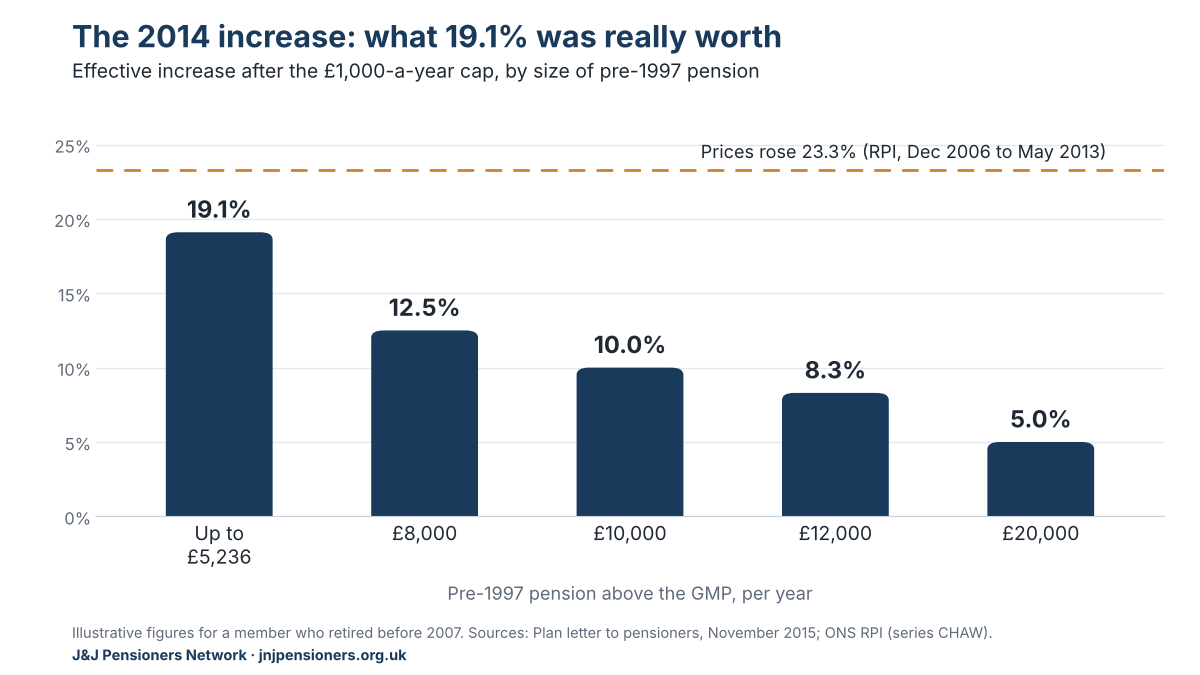
A large pre-1997 pension usually reflects long service before 1997. So the members who had given the most years to the Company received the smallest share of the catch-up. Someone with £20,000 a year of pre-1997 pension above the GMP received 5%, against the 21% that 90% of RPI would have given, and against the 23.3% by which prices had actually risen.
The October 2007 increase had the same shape. At 9.5% with a £500 cap, it too was paid in full only where pre-1997 pension above the GMP was below about £5,263 a year. In both of the last two catch-ups, the stated percentage was a ceiling that the longest-serving members did not reach.
How this fits the 90% of RPI story
For three decades the message to members was consistent. Increases were made from at least the mid-1980s, every year at first and then as periodic catch-ups. Those catch-ups were pitched at 90% of RPI, and as late as November 2015 members were told that 90% was “the level of inflation protection the Company has targeted.”
The 19.1% increase is where that benchmark began to slip. Before any cap applied, it was already below the Company’s own earlier yardstick, because it was measured on CPI. For anyone with more than about £5,236 a year of pre-1997 pension above the GMP, the cap took it further below. Then the increases stopped altogether. Members were never told that the target had changed.
The cost of that is now large. Had pre-1997 pension above the GMP been increased by 90% of RPI each April since 2014, the same basis as the 2002, 2004 and 2007 catch-ups, a £10,000 pension would now be about £15,840 a year. It is still £10,000.3[3]Office for National Statistics, RPI All Items, percentage change over 12 months (series CZBH), September readings 2013–2025, which set the April 2014 to April 2026 increases. 90% of each reading, compounded. Calculations by the Association.
Why it matters now
The 19.1% was granted while the Plan was in deficit: 91.8% funded at 31 March 2015.4[4]Plan Summary Funding Statement 2015: shortfall of £160.1 million, 91.8% funded, at 31 March 2015. Today the Plan reports a surplus of £484 million, 133% funded, at 31 March 2025, and the employers have paid nothing towards benefits since it closed to accrual in April 2023.5[5]Mercer actuarial report as at 31 March 2025. The figure carries no allowance for any adjustment arising from the Virgin Media litigation (Verity Trustees v Wood). The Plan’s 2026 valuation completes in 2027, the same year new rules are expected to make it easier to pay surplus to employers. The Pensions Regulator has said trustees considering a release should weigh “whether members have a reasonable expectation to share in surplus, especially if discretionary benefits have been regularly granted.”6[6]The Pensions Regulator, statement on new defined benefit surplus flexibilities, 10 June 2026 (updated 21 August 2026).
Any settlement of the pre-1997 question should therefore start from the Company’s own long-standing benchmark, 90% of RPI. And it should not be capped in a way that gives the least to those who served longest.
References
- Plan letter to pensioners, November 2015, issued by J & J Pension Trustees Limited, c/o Mercer Limited: special increase of 19.1% (90% of the rise in CPI, December 2006 to May 2013), effective January 2014, paid December 2015 with arrears; cap £1,000 a year; pro-rated for retirements after 31 December 2006 and not payable to those who retired after 30 June 2013; earlier special increases in April 2002, September 2004 and October 2007 at 90% of RPI; October 2007 increase 9.5% with a £500 cap.
- Office for National Statistics. RPI All Items index (series CHAW, January 1987 = 100): December 2006, 202.7; May 2013, 250.0. CPI index (series D7BT, 2015 = 100): December 2006, 81.3; May 2013, 98.5. Calculations by the Association.
- Office for National Statistics, RPI All Items, percentage change over 12 months (series CZBH), September readings 2013–2025. Calculations by the Association.
- Plan Summary Funding Statement 2015 (position at 31 March 2015).
- Mercer actuarial report as at 31 March 2025 (Adam Tidey FIA). No allowance for any adjustment arising from the Virgin Media litigation (Verity Trustees v Wood).
- The Pensions Regulator, “New defined benefit surplus flexibilities”, 10 June 2026, updated 21 August 2026.
This article is published by the J&J Pensioners Network, the public-facing name of The J&J UK Pensions Voluntary Association. It is based on the Plan’s own communications, official ONS data and published Plan documents. The worked figures are illustrations, not any individual member’s entitlement. This does not constitute financial, legal or actuarial advice. The Association welcomes correction of any factual inaccuracy in writing to info@jnjpensioners.org.uk. © The J&J UK Pensions Voluntary Association, October 2026.