Who we are
We are a group of volunteers — all former J&J UK colleagues — who care deeply about the pension community. Like many of you, we are pensioners or members with deferred benefits in the Johnson & Johnson UK Group Retirement Plan.
We are independent, unpaid, and committed to doing what is right for members. Our focus is on clarity and fairness — helping members understand what is happening and engage with it directly, rather than acting as anyone's substitute.
We are former colleagues looking out for one another — helping members understand a complex system and stay informed, so that important decisions affecting the scheme do not go unnoticed and members can engage on their own terms.
Since April 2026 the Network has operated through a formally constituted body, The J&J UK Pensions Voluntary Association, which writes on members' behalf to the Trustee, the Participating Employers and other parties. You may see correspondence and articles signed in the Association's name — this is the same group of volunteers, simply acting through its formal structure.
Why we exist
Pensioners and deferred members of this scheme currently have no formal voice in decisions about it — including decisions about a reported £484 million surplus. That is not a choice made by any one employer or trustee; it reflects what current UK pension law and governance rules permit for a scheme run by a sole professional trustee. J&J Pensioners Network exists to help members understand how that system works in practice, using our own scheme as a clear, documented example — its governance, its funding, its surplus, and specific issues such as the long‑standing disparity affecting pre‑1997 pensions. We bring together publicly available information, raise the questions members are asking, and press the Trustee and the Company for the engagement, transparency and fairness that we believe members are entitled to — so that members can see clearly what is happening, ask their own questions, and add their own voice to the case for change.
What we aim to achieve
The Network works constructively with the Trustee and Johnson & Johnson to ensure the Pension Schemes Act 2026 delivers for members as well as the Company.
Act as an independent collective voice
Representing the shared interests of pensioners and deferred members by raising themes, questions, and concerns with the Trustee and the Company in a clear, evidence‑based, and respectful manner.
Advocate for fair discretionary increases
Supporting fair, responsible increases that maintain members' spending power, with particular focus on benefits built up before April 1997, which carry no statutory minimum increase guarantee.
Promote a balanced and equitable funding strategy
Encouraging the Trustee and the Company to adopt a holistic approach to scheme funding that considers affordability, fairness, and long‑standing pensioners’ needs before any surplus is extracted or returned to the Company.
Foster communication and transparency
Helping build stronger connections between members, the Trustee, and the sponsoring employer by sharing information, clarifying developments, and encouraging open dialogue.
Support informed engagement
Helping members understand where to find official information, how decisions are made, and what channels exist for raising questions or concerns.
Help shape the regulations under the Pension Schemes Act 2026
Much of the Act's detail, including the rules on releasing DB surplus, will be set in secondary legislation. The Network will respond to relevant consultations to help ensure members' interests are reflected.
Where things stand
On 27 May 2026, the Association wrote formally to three parties: Ross Trustees Services Limited (trading as Independent Governance Group, or IGG), the Plan's sole trustee; a senior HR manager at Johnson & Johnson who is a signatory to the Plan's Statement of Funding Principles; and the Managing Directors of a number of J&J Affiliates — the five companies that currently participate in the Plan as employers.
In summary, we asked for:
- A formal, documented member engagement process before any decision is made on the £484m surplus.
- Independent actuarial advice on the cost of addressing the pre‑1997 indexation disparity, treated as a priority claim on any member share of surplus.
- No surplus distribution resolution to be passed until those steps are complete.
- A single structured meeting (by Teams or Zoom, given how widely members are spread) between the Association, IGG, and representatives of all five Participating Employers.
- From the employers specifically: a named HR or pensions contact for members' enquiries.
These letters do not allege unlawful conduct. Each governance change described below was made lawfully. Our concern is that none was preceded by member consultation, and that there is currently no formal mechanism for members’ views to be heard before decisions are made about the £484m surplus. (The IDRP provides a formal complaints channel, but only after decisions have been taken, not before.)
Who governs the Plan now
Since 1 May 2023, the Plan has had a single trustee: Ross Trustees Services Limited, trading as Independent Governance Group (IGG). The previous corporate trustee vehicle, J&J Pension Trustees Limited, was formally dissolved on 1 April 2025. IGG is a commercial Professional Corporate Sole Trustee (PCST), backed by private equity investors — LDC since 2020, joined by ECI Partners in late 2024 — and acts as trustee to several hundred pension schemes, with combined scheme assets reported at around £320bn.
Under the PCST structure, the usual legal requirement for at least one‑third of the trustee board to be member‑nominated does not apply. This is lawful — the PCST exemption under Regulation 2(k) of the 2006 Regulations explicitly permits it. There is no legal obligation to consult members before governance changes or surplus decisions. But lawfulness is not the same as best practice, and the Regulator itself has identified this gap.
Pensions erosion summary
Most members' pensions are built up over different periods. Benefits accrued before April 1997 carry no statutory increase guarantee — it's specifically this pre‑1997 portion that has received nothing since 2014. The more of a member's career that falls before April 1997, the harder they are hit — a member who joined in 1974 and retired in 2014 has 57% of their pension in the frozen tranche, regardless of when they actually retired.
- Governance changes made through multiple legal documents over several years.
- Members not directly involved in discussions about the growing scheme surplus.
- The pre‑1997 portion of many members' pensions has received no increase for 12 years — hitting those with the most pre-1997 service hardest.
- Decisions before April 2027 may shape how future surplus funds are used.
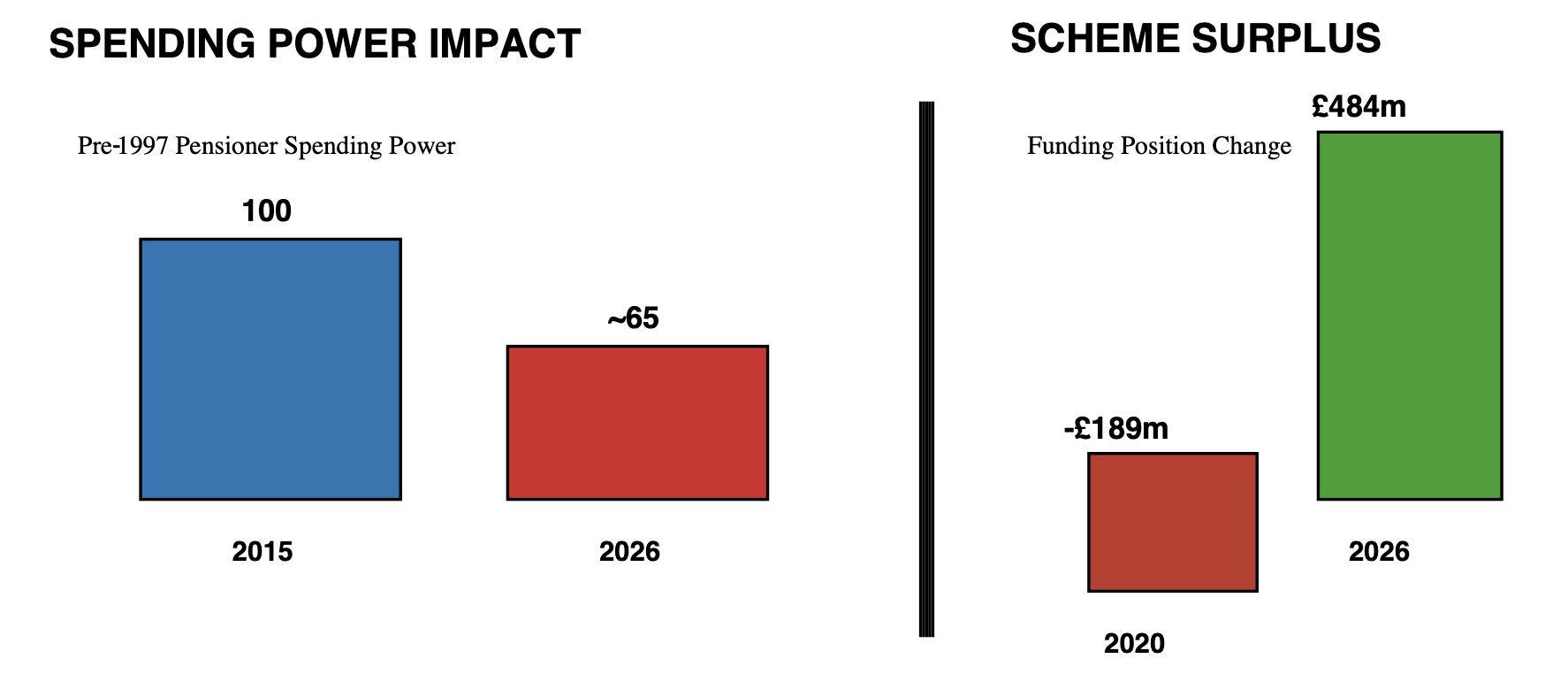
The last increase was applied in January 2014 at 19.1% — a periodic catch-up (the fourth since 2002), covering only the portion in excess of the Guaranteed Minimum Pension. Even on that periodic schedule a further catch-up would have been due years ago. Based on actual published RPI data since 2014, the real‑terms loss on the pre‑1997 tranche is estimated at 37% — meaning a pre‑1997 pension worth £10,000 in 2014 now buys roughly what £6,280 would have bought back then. Post‑1997 members have received statutory increases throughout.
Download the full one‑page summary (PDF)Correspondence so far
We will keep this section updated as a running record of formal correspondence between the Association and the Trustee, the Company, and the Participating Employers — including dates, what was asked, and what (if anything) was received in response.
A member wrote to Aptia, the scheme's administrator, asking two questions: when was the last discretionary increase made to pre‑1997 pension benefits, and did the Trustee intend to make one given the scheme was then 130% funded? Aptia confirmed the last increase was applied in January 2014, at 19.1% on the pre‑1997 element in excess of GMP — and that the Company's position remained that increases would only be provided where legally required.
Following Aptia's response, a formal request was made directly to IGG as Trustee, asking it to circulate a communication to all members with pre‑1997 benefits explaining that no discretionary increase had been applied since January 2014. IGG did not respond promptly; a follow‑up was required. IGG eventually acknowledged the request but indicated it would not circulate the communication.
Following IGG's refusal, a formal complaint was lodged under the Plan's Internal Dispute Resolution Procedure (IDRP), alleging lack of transparency and failure to demonstrate independence from the Company. The complaint was acknowledged by IGG on 13 November 2025.
IGG issued its formal IDRP decision, declining to uphold the complaint. Key points from its response: the Trustee has no unilateral power to award discretionary increases — only the Company can authorise them; the Company's "global practice" is to provide inflation adjustments only where legally required; and the Trustee does not consider it appropriate to use its communication channels to "take a position" on member benefit matters. Notably, IGG's own letter acknowledged that the Participating Employers are "potential beneficiaries under the Plan" — meaning they have a financial interest in how surplus is used alongside members.
Following an email campaign by the HPPA Alliance, a number of MPs wrote to the Pensions Minister on behalf of their constituents regarding discretionary indexation of defined benefit pension schemes. Torsten Bell MP, Minister for Pensions, issued a formal ministerial response that was circulated as a standard reply to multiple MPs. The letter stated:
“Trustees will be in the driving seat in all decision making on surplus release and have a duty to act at all times in the interest of scheme beneficiaries. Employers will have no direct access to surplus funds and trustees are within their rights to request conditions that include the payment of discretionary indexation to members as part of any agreement which leads to the release of surplus to the employer.”
The minister further noted that the Pensions Regulator already expects trustees to consider whether members would benefit from a discretionary increase and whether the scheme has a history of making such awards — and that legislative changes will give trustees of well-funded schemes more scope to agree discretionary increases with employers. This scheme is well-funded. This scheme has a history of making such awards.
Following IGG's IDRP decision, a formal complaint (case reference CAS-153952-T7V1) was submitted to The Pensions Ombudsman, concerning the Trustee's refusal to circulate a member communication on pre-1997 discretionary increases and related concerns about transparency, independence, and engagement with members. Two follow-up emails providing clarification were sent on 12 and 18 December 2025.
A letter was sent to J&J's Chief Executive asking the Company to commit, from April 2026, to resuming discretionary increases on pre‑1997 pension benefits, noting the scheme's strong funding position and the twelve-year gap since the last increase.
The Pensions Ombudsman confirmed the application had been logged and passed to its Assessment Team, with an estimated 8 weeks before the team would make contact to explain next steps.
A response was received from a senior HR manager at Johnson & Johnson on behalf of the Company. It stated: "At this time, there is no intention by the plan sponsor to amend the plan benefits by awarding a discretionary increase in excess of those set out under the Rules." The response added that J&J "remains committed to managing our pension plans in accordance with plan terms and applicable law."
The Pensions Ombudsman wrote again to confirm the complaint will be passed to a Case Assessor, who will assess in detail whether it is something the Ombudsman can investigate. The estimated timescale to allocate the case to a Case Assessor was given as around 15 months. The Association will provide an update once the case progresses.
A further letter was sent to J&J's Chief Executive, signed by Graeme Crawford — a member of the group, with 31 years' service — on behalf of a long list of named former employees, following up on the 13 December 2025 letter and the 4 February 2026 response. It asked the Company to reconsider its position in light of the Credo and the scheme's strong funding position. The letter was acknowledged but did not receive a substantive reply.
Members agreed a constitution and rules and formed The J&J UK Pensions Voluntary Association (renamed from an earlier working title on 11 June 2026), giving the Network a formal legal structure through which to correspond on members' behalf.
Formal letters were sent to Ross Trustees Services Limited (IGG) as sole trustee, to a senior HR manager at Johnson & Johnson, and to the Managing Directors of a number of J&J Affiliates — setting out the five specific asks summarised in "Where things stand" above. Each letter requested a substantive response within 28 days. These letters followed nine months of good‑faith direct engagement through formal channels before the Association was involved.
The 28-day response window from the 27 May letters closed on 24 June 2026. IGG (Ross Trustees Services Limited) acknowledged receipt of the Association’s letter but did not provide a substantive response by the deadline. Johnson & Johnson has not responded at all. The Association is now considering its next steps.
Following the expiry of the 28-day response window without a substantive reply from either IGG or Johnson & Johnson, the Association submitted a formal complaint to The Pensions Regulator (TPR) concerning the governance of the Johnson & Johnson U.K. Group Retirement Plan. The Association is not in a position to publish the details of that complaint at this stage. It will provide an update when it is able to do so.
IGG (Ross Trustees Services Limited) responded in writing. Key points from that response:
- IGG confirmed the Trustee is “not currently considering any payment of surplus assets to the Participating Employers,” and that no discussions with the Participating Employers have taken place regarding a payment of surplus assets.
- IGG stated its member engagement is provided “where full member engagement is legally required.”
- IGG confirmed it requests discretionary increases from the Company annually and triennially, and that the Company has declined each time, most recently ahead of April 2026.
- On the LinkedIn video presentation by Richard Cousins referenced in the Association’s letter, IGG stated this “was not in relation to Johnson and Johnson or the Plan” and that Mr Cousins “has no involvement with the Plan.” The Association records this denial. It addresses only the video — not the separate, written case study published on IGG’s own website and signed by Grant Suckling, one of this Plan’s own trustee directors, which remains formally unanswered.
- IGG did not address the Association’s request for independent actuarial advice on the cost of providing discretionary increases to pre-1997 members, and declined the Association’s request for a multi-party meeting, indicating the correspondence was “sufficient to answer the points raised.”
At a member's request, their MP wrote to the Rt Hon Pat McFadden MP, Secretary of State for Work and Pensions, seeking clarification on two points ahead of the DWP's surplus flexibilities consultation: first, whether the final regulations will require trustees to demonstrate they have considered whether historic indexation gaps should be addressed for members before any surplus is released to an employer; and second, whether the Government will require meaningful member consultation before a surplus release decision is finalised, rather than notification after the fact.
Separately, another member of the scheme received a reply from their own MP, Euan Stainbank MP, following correspondence on the same issue. Mr Stainbank's letter made a point worth recording: “If Parliament has accepted that pre-1997 indexation protection matters enough to legislate for PPF members, that same logic does not disappear simply because a scheme happens to remain solvent. If anything, a scheme sitting on a substantial and growing surplus… is better placed to fund it than one in distress.” The letter also confirmed that Dame Nia Griffith and Peter Swallow raised the pre-1997 indexation gap during the passage of the Pension Schemes Act 2026, and that ministers acknowledged the gap for non-PPF members without yet committing to close it.
Responding to the 8 July letter, the Minister for Pensions confirmed the Government's position in writing. Key points:
- The Government “recognises that the absence of indexation on pension rights, accrued before April 1997, can erode the value of pensions over time and affect members.”
- The Minister stated he has “met with many of them to ensure that their voice is heard when it comes to policy-making.”
- The Government will not retrospectively mandate pre-1997 indexation on a blanket basis, on the basis that “all recent Governments… have not thought it was appropriate” to add liabilities to schemes this way.
- The letter repeated that the Pensions Regulator “expects trustees to consider whether members would benefit from a discretionary increase, and to take account of any history of making such awards” — and confirmed TPR will issue further guidance on this, including examples such as benefit enhancement, shortly after the Regulations come into force.
- On member involvement, the letter described “member notification” as one of the safeguards attached to any surplus release — not the meaningful, pre-decision consultation the member's letter had specifically asked for.
Separately from the Association's own correspondence, a member of the scheme had written to their own MP on 27 June 2026 about the Pension Schemes Act 2026, asking a direct question: would members be told and asked before money is taken out of their pension scheme, not just told after the decision had already been made? The MP's reply, received on 22 July, confirmed that members “must be notified before payments of surplus to employers are made,” and pointed to trustees' fiduciary duty as a safeguard.
The member has shared this exchange with the Association, with identifying details removed. It illustrates a pattern the Association has seen elsewhere: a reply confirming notification to a question that asked about consultation — two different things. It also illustrates the same fiduciary duty gap set out in our article “A Duty With Almost Nothing to Bite On”: a general duty to act in members' interests provides less reassurance where the trustee has confirmed, in writing, that it holds no discretion over the specific decision that matters most.
Johnson & Johnson responded, on behalf of the Participating Employers, to the Association's letters of 27 May 2026. The response acknowledged receipt, confirmed the Company “will continue to manage the Plan in accordance with its terms and applicable law,” and confirmed that, at this time, there is “no intention to amend the Plan benefits by awarding a discretionary increase in excess of those set out under the Rules of the Plan” — materially the same position previously given by J&J's HR Lead for Northern Europe on 4 February 2026.
The response did not address the Association's specific requests: the multi-party meeting, the pre-1997 indexation disparity, the Statement of Funding Principles, or the amended Rule 19 consent mechanism were not engaged with. The Association records this as a response received, but not one that engages with the substance of the matters raised.
IGG responded further, in reply to the Association's letter of 4 July 2026. Key points from that response:
- IGG confirmed it is “not currently considering any proposal relating to the payment or distribution of surplus assets,” and stated that, accordingly, “there is no requirement at the present time for the Trustee to undertake any consultation with the membership.”
- On the case study raised previously, IGG stated it “does not consider it appropriate to continue to comment on whether any particular pension scheme is, or is not, referenced” in its marketing publications — declining to comment further, rather than repeating or extending the specific denial given on 3 July regarding the LinkedIn video.
- On the Association's request for independent actuarial advice on the cost of pre-1997 increases, IGG stated it will determine what professional advice it requires and obtain it as it considers appropriate.
- The request for a multi-party meeting was declined. IGG stated it does not consider a meeting would assist at this time, that the Association's views have been clearly set out in correspondence, and that they will be “considered alongside any views received from other members and beneficiaries.” IGG added that it “cannot accord any particular status or standing to the views of any individual member or group of members.”
- IGG stated it has “no further comments to make on the matter,” and pointed the Association to the Plan's Internal Dispute Resolution Procedure if dissatisfied.
What we’re working on
The Network focuses on practical, member‑centred work. We keep an eye on developments and highlight what matters most to you.
- Seeking formal member engagement with the Trustee ahead of any surplus distribution decision.
- Engaging with the Trustee and J&J to ensure members’ interests are properly represented in decisions about the scheme’s surplus.
- Reviewing scheme communications and key decisions.
- Monitoring governance.
- Supporting members with questions and concerns.
- Raising awareness among former J&J colleagues.
- Building a stronger, more connected pension community.
- Tracking the consultations on regulations under the Pension Schemes Act 2026 and responding where they affect members.
What we've published
The Association has published ten member articles setting out the evidence behind our concerns — fully sourced, written in plain English, no pensions jargon. Click any heading below for a short summary, then follow the link through to read the full article.
The accessible version of the Association's full case: the £484m surplus, six governance changes since 2020, the IGG case study, and what you can do. If you read only one article, read this.
Read the full article →A forensic, change-by-change account of five years of governance decisions — none preceded by member consultation — and the direct question they raise. Covers the same six governance changes previously summarised on this page, in full detail with sources.
Read the full article →IGG says it has "no discretion to exercise" on pre-1997 increases. The Minister for Pensions says trustees can make indexation a condition of releasing surplus. Both statements are true — read together, in IGG's own words, they reveal a duty with almost nothing left to act on.
Read the full article →The 1990s contribution holiday, the decade of annual increases, the equity crash — and why the second contribution holiday is fundamentally different from the first. Covers the historical context and funding-history data previously summarised on this page, in full detail with sources.
Read the full article →What a 2005 retiree was promised — and the silence that followed. A composite account, built entirely from documented Plan newsletters and figures, of the tradition of increases that quietly ended in January 2014 with no letter ever sent to say so.
Read the full article →The Association has submitted its full response to the DWP consultation on pension surplus release — nineteen questions, answered with the documented facts of our own scheme. What we argued, in plain English, and the full submission to download.
Read the full article →IGG has also submitted its own response to the DWP consultation. It asks the Government to protect trustees from being removed by an unhappy employer — but asks for no equivalent protection for members. A close reading of what IGG said, and what it didn't.
Read the full article →In June, TPR published a case study showing trustees securing 50% of a surplus release for members. In August, it quietly clarified that figure isn't a benchmark after all. What changed, what didn't — and why it proves the case for writing protections into the regulations themselves.
Read the full article →Year-by-year RPI data shows a 37.2% real-terms loss on pre-1997 pensions since January 2014. The surplus was built partly at the expense of members' retirement income.
Read the full article →J&J says giving back is at the heart of what it does. In the UK and the Netherlands, its own pensioners have waited 12 and 18 years respectively just to be given back what inflation has taken.
Read the full article →Music
Some of our articles have a companion piece: a short song, written from a member's point of view, telling the same documented story a different way. Click any title to watch, or read the full article behind it.
What a 2005 retiree was promised — and the silence that followed. The story of thirty years of trust, and the letter that never came.
Read the full article →What Johnson & Johnson says about giving back — and what its own pensioners in two countries say about being asked to wait.
Read the full article →A decade of trust, a contribution holiday, and increases that quietly stopped — the story of how members were lulled into believing nothing had changed.
Read the full article →Twelve years of frozen pre-1997 pensions, a £484 million surplus — and a question about where the money that should have kept pace with inflation actually went.
Read the full article →A fiduciary duty that sounds absolute in principle, and almost nothing left for it to act on in practice — the trustee has told us in writing it has “no discretion to exercise.”
Read the full article →A decade of trust, a contribution holiday, and increases that quietly stopped — asking, plainly, why the music stopped and why no one ever said so.
Read the full article →What the Association told the Government about surplus release — nineteen questions, answered using the documented facts of our own scheme.
Read the full article →A pension that stopped keeping pace, and the members left to notice on their own.
Twelve years of silence, and the quiet toll of being told, over and over, that it simply isn't a priority.
Six governance changes in five years. None preceded by member consultation. Set out the sequence, and judge for yourself.
Read the full article →The decades of benign behaviour by the Trustees created such confidence in the pensioner community that it took over 10 years for any of them to realise their trust was misplaced.
When a J&J pensioner dies, their surviving spouse is left with just 50% of the pension they built their retirement around — and that reduced pension is frozen for pre-1997 service exactly the same as it always was.
How to join
Joining the J&J Pensioners Network is completely free and open to:
- Pensioners of the Johnson & Johnson UK Group Retirement Plan.
- Members with deferred benefits.
- Former J&J UK employees who were part of the Johnson & Johnson UK Group Retirement Plan.
Fill in the form below and we'll be in touch:
If you have already been accepted as a member of the Association there is no need to complete this form.
Privacy: Information submitted is used solely to administer your membership of The J&J UK Pensions Voluntary Association. It is not shared with third parties. You may request removal of your data at any time by writing to info@jnjpensioners.org.uk.
We welcome voluntary donations from members to support the work of the Network, but there is no membership fee and no obligation to donate when joining. To make a donation, please use the following bank details:
Sort code: 30-54-66
Account number: 88142768
Reference: Please use your name
Tell your friends
Many former colleagues still do not know the Network exists. If you are in touch with anyone who:
- Worked for J&J in the UK, and
- Is a pensioner or has deferred benefits, or
- Was part of the Johnson & Johnson UK Group Retirement Plan,
…please tell them about us and encourage them to get in touch.
Frequently asked questions
- Help explain pension news in plain English — we summarise key updates without jargon.
- Keep an eye on scheme communications — we highlight important announcements and spot issues affecting members.
- Raise common concerns collectively — we feed back themes and questions that matter to pensioners and deferred members.
- Share independent insights — we review publicly available information and point out what’s most relevant.
- Support members with general questions — we help people understand where to look and who to contact.
- Build community — we connect former colleagues, share updates only when needed, and encourage transparency and fairness.
- We’re not part of the official pension scheme — we’re independent volunteers, not J&J, the Trustee, or XPS.
- We can’t give financial or legal advice — for regulated guidance, members should speak to a qualified adviser.
- We can’t look into individual pension cases — only the scheme administrator can calculate or verify personal benefits.
- We can’t handle complaints or disputes — formal issues must go through the official J&J Pension Plan process.
- We can’t act on your behalf — we’re not legal representatives and can’t intervene in decisions or appeals.
- We don’t hold pension records — any personal information stays with the scheme; we’re not a data controller.
- We’re not linked to political or commercial groups — we stay fully independent and non‑affiliated.
Any pensioner or deferred member of the Johnson & Johnson UK Group Retirement Plan, and former J&J UK employees who were part of that scheme.
Yes. There is no membership fee and no obligation to donate. We do welcome voluntary donations from members to support the work of the Network. To donate, please transfer directly to:
Account name: J&J UK Pensions Voluntary Association
Sort code: 30-54-66
Account number: 88142768
Reference: Please use your name
Yes. We are entirely independent. We are former colleagues acting in the interests of members, not on behalf of the company.
Our members are based all over the UK, and some live overseas. To make sure everyone can take part, we hold meetings online and use digital tools for any voting or decision‑making. This ensures that all members — wherever they live — can participate on an equal footing.
Volunteers review information, monitor developments affecting the scheme, discuss concerns, and help communicate important updates to members in clear, straightforward language.
We only contact members when there is something important or useful to share. We aim to keep communication relevant and respectful of your time.
The 24 June 2026 deadline passed without a substantive response. IGG has since responded in full, on 3 July 2026, and Johnson & Johnson responded on 5 August 2026 — see the correspondence timeline above for what both said. Neither response engaged with the Association's specific requests, including the multi-party meeting. The Association has also submitted its full response to the Government’s consultation on surplus flexibilities — see “What We Told the Government” — and continues to press for a meeting with the Trustee and Participating Employers. Updates will be published here as they happen.
Not as far as we are aware, and we do not allege otherwise. Each of the governance changes we describe was made lawfully by parties with the legal power to make it, and the current trustee structure (a Professional Corporate Sole Trustee) is a recognised, lawful governance model. Our concern is one of governance practice and fairness: that none of these changes was preceded by member consultation, and that there is currently no formal governance mechanism for members' views to be heard before decisions are made on the £484m surplus. The IDRP provides a formal complaints channel, but only after decisions have been taken — not a proactive voice in governance.